

Project Overview
SGI Composites was appointed by Solomon, based on the remote island of St Helena, to deliver a complete fuel tank lining refurbishment for three critical steel storage vessels. The brief was to specify and apply a durable, fuel-resistant epoxy tank coating system that would:
- Protect the internal steel surfaces from corrosion and leakage
- Reduce environmental and operational risk
- Work reliably in a challenging, remote location with limited local resources
From the first enquiry it was clear this would not be a standard UK tank lining project. The tank farm sits on a small island in the South Atlantic, accessible only via a sequence of long-haul flights and with restricted shipping capacity. SGI Composites took responsibility not only for the technical solution, but also for the complex planning, procurement and logistics needed to deliver the works safely and on schedule.
Understanding the brief and constraints
The project began with an enquiry and a significant amount of correspondence between Solomon and the SGI Composites technical team. This early dialogue focused on building a clear picture of the assets and the operational context, including:
- Tank construction, dimensions and existing lining/coating condition
- Current and planned usage patterns for the fuel storage tanks
- Available shutdown windows and the impact of downtime
- Site safety requirements and environmental expectations
Because of the remoteness of St Helena and the importance of the tanks to the island’s fuel infrastructure, the solution had to be technically robust, practically deliverable and fully aligned with the client’s risk profile. It quickly became clear that a dedicated site survey would be required to validate assumptions and refine the tank lining specification.


Planning, procurement and container logistics
With the technical approach agreed, the focus moved to planning and logistics. On a remote project, getting the right materials and equipment to site at the right time is critical, as there is almost no scope to “run back to the yard” for forgotten items.
SGI Composites:
- Agreed target dates with Solomon that balanced tank availability, flight timetables and local conditions
- Developed a labour plan that ensured sufficient trained operatives were on site for the duration of the works
- Compiled a comprehensive list of all required tank lining/coating materials, consumables, grit, PPE and spares
All materials and equipment were then packed into containers and despatched to Immingham Port approximately two months in advance. The containers were loaded in a logical order to support efficient unloading on St Helena and to minimise unnecessary handling once on site. When the containers arrived on the island they were sited within a short distance of the work area, improving safety and productivity.
With the containers on their way, the SGI Composites installation team mobilised via Heathrow and Johannesburg, ultimately arriving on St Helena to begin the on-site phase of the project.
Before any work inside the tanks could begin, SGI Composites established a safe, compliant working environment. This was particularly important given the confined-space nature of the job and the fact that the tanks were part of an operational fuel facility.
Key measures included:
- Confined-space entry procedures, permits and rescue planning
- Atmospheric monitoring and ventilation arrangements
- Installation of extraction systems to control dust and fumes
- Provision of suitable lighting within each vessel
- Clear demarcation of the work area and equipment zones around the tanks
Only once this safety framework was in place did the team move on to preparation and lining.


Tank preparation and surface treatment
The quality and longevity of any epoxy tank coating depends on the condition of the substrate. SGI Composites followed a disciplined preparation sequence to ensure the steel was clean, sound and properly profiled.
The process for each tank included:
-
Cleaning and drying
The team ensured that each vessel was free from residual fuel, loose contaminants and standing liquid. This created a stable base for subsequent mechanical preparation.
-
Set-up of blasting equipment
Internal access points, blast hoses, lighting and extraction were configured to allow safe and effective grit blasting across walls, floors, tie bars and brackets.
-
Grit blasting
The internal surfaces were grit blasted to remove existing coating failures, rust and surface contamination. This produced a controlled surface profile, providing an optimal “anchor pattern” for the epoxy system.
-
De-gritting and fine cleaning
Once blasting was complete, spent blast media was removed. The team swept and hoovered the tanks to eliminate dust and debris. All spent grit was placed into receptacles provided by Solomon for client-managed disposal.
At the end of this stage, each vessel presented a clean, dry and well-profiled steel surface ready for the application of the new tank lining system.


Application of the fuel-resistant epoxy tank lining system
With preparation completed, SGI Composites installed a two-coat, fuel-resistant epoxy tank lining/coating designed to protect the steel from hydrocarbons, water and associated contaminants.
The application sequence combined brush-applied detailing with airless spray for larger areas:
Joint and detail sealing
A fuel-resistant sealant was first applied to wall and floor panel joints and around bracket perimeters. This step helped to seal potential leak paths at interfaces and transitions.
First stripe coat
An epoxy stripe coat was then applied by brush to all critical details such as joints, brackets, bolts, tie bars and tight corners. This ensured additional film build at vulnerable points that are often the first to suffer coating breakdown.
First full epoxy coat (airless spray)
Using airless spray equipment, SGI Composites applied the first full coat of epoxy to the walls, floors, brackets and tie bars. Spray application gave a uniform film thickness and efficient coverage in the confined tank environment.
Second stripe coat
After appropriate curing, a second stripe coat was brush-applied to the same critical areas. This further reinforced protection at edges, welds and fixings where stress, movement and local turbulence may be higher.
Second full epoxy coat (airless spray)
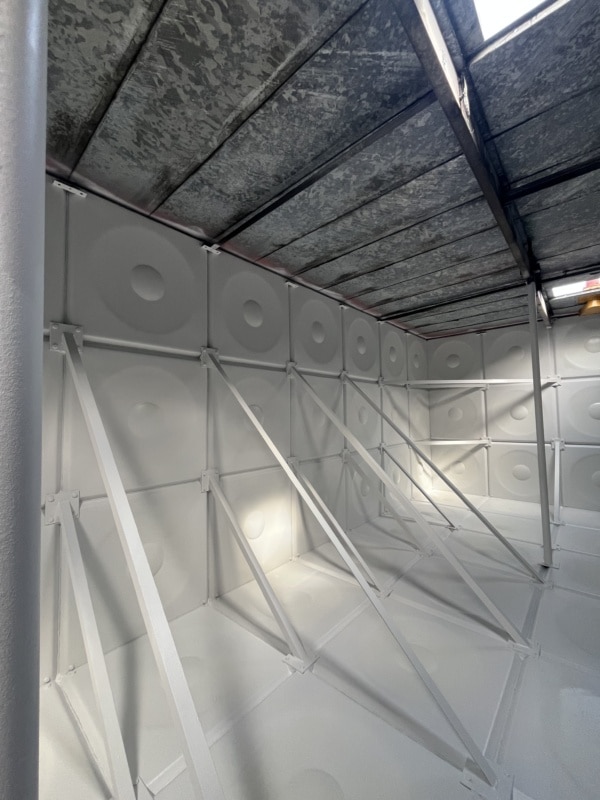
A second full spray coat of epoxy was then applied over all internal surfaces, building the overall dry film thickness to the specified level and providing a continuous, fuel-resistant barrier across the entire tank interior.
Once coating operations were finished, each vessel was vented to assist curing, allowing the epoxy system to achieve its designed mechanical and chemical properties before the tanks were brought back into service.
Extending the process across three tanks and handling defects
The complete methodology was repeated across all three vessels in the tank farm. The programme was sequenced to maintain progress whilst allowing adequate curing time between stages and minimising overall downtime for the client.
During final inspections, any localised defects, pinholes or areas of insufficient coverage were identified and rectified. SGI Composites re-prepared these areas as required and re-applied the epoxy system using the same combination of stripe coating and full coats. This approach ensured:
- Full, continuous coverage across all internal surfaces
- Consistent film build, including at joints and complex details
- A uniform, professional finish ready for client inspection and re-commissioning

Outcomes and benefits of a high-performance epoxy lining system
By refurbishing the internal surfaces of the three tanks with a high-performance epoxy lining system, Solomon has gained:
- Extended asset life, with internal steel protected from corrosion and chemical attack
- Reduced risk of leaks, product loss and environmental incidents
- Improved integrity of critical fuel infrastructure on a remote island with limited redundancy
- Documented assurance that the work has been carried out by a specialist tank coating contractor using a structured, auditable process
The project demonstrates that a correctly specified epoxy fuel tank lining can provide a robust, long-term solution even where access and logistics are challenging.

Demonstrating SGI Composites’ capabilities
This case study highlights SGI Composites’ ability to deliver complex industrial tank lining projects for fuel storage operators and tank farm owners, both in the UK and overseas. The combination of technical expertise, thorough site investigation, rigorous safety standards and meticulous planning enabled the team to complete a demanding, confined-space project safely and efficiently in one of the more remote locations in the world.
For organisations requiring tank lining, tank coating, bund lining or industrial coating solutions – particularly where assets are remote, critical or difficult to replace – SGI Composites provides a full, end-to-end service:
- Site surveys and tank condition assessments
- Project-specific coating and lining specifications
- Material procurement, logistics and on-site delivery
- Installation, inspection, client walkthrough and handover
The Solomon, St Helena project is a strong example of how SGI Composites can protect vital fuel storage assets with durable, fuel-resistant tank lining systems, even when the site is far from straightforward to reach.
